

As technology and AI provide new ways for modernising financial advice practices, we look at how AI is evolving, how advisers can start integrating its capabilities, and the investment Macquarie is making in its platforms to support advisers and deepen their client relationships.
Part 2: Zooming in – navigating and leveraging AI advancements in your business
 Adam Hett, Head of Wealth Technology, Macquarie, showcased key investments Macquarie is making in its Wrap platform and the new functionalities advisers can expect.
The speed with which AI capabilities are evolving can make knowing where to start especially daunting for small and medium-sized businesses.
“Start by being really clear on what you want AI to deliver for your business,” said Paul Migliorini, Vice President Google Cloud Australia and NZ, who unpacked for advisers in the audience how AI is evolving, and how to cut through decision paralysis caused by the proliferation of tools, models and integration options.
“Focus on the outcomes you want rather than the technology you think you need,” he said. “Success doesn’t depend on picking the ‘right’ AI model, it comes from thinking long-term and being prepared to iterate.”
Rather than seeing the introduction of AI as a one-off deployment, advisers should outline what success looks like for them over an extended period and the actionable, incremental steps they will take toward that.
“The mistake people make is they think about it as a point in time – 'I'm going to deploy this model or this agent against this problem today.' The better outcome is to say, 'I want to be the most advanced financial adviser ten years from now' and then identify and deploy new capabilities against that,” said Migliorini.
He paralleled the opportunity for the adviser industry – where relationships and individual context provide a key competitive advantage – with the recent announcement of Google Spark, its new personal AI agent. Integrated across a user’s Google apps, Spark can draw on additional context to go beyond answering questions and act on the user’s behalf, based on their instructions.
“The most valuable asset all of you have is context. Finding a way to continuously bring that to the top of the conversation can help you stand out,” he said.
“If your outcome is to be the most contextually aware adviser your client has ever had, then every investment you make should feed that outcome – regardless of which AI model or agent framework you're using at any given moment.”
 Oliva McArdle, Head of Deposits and Payments at Macquarie Bank, discusses the opportunity for AI in the adviser space with Paul Migliorini, Vice President Google Cloud Australia and NZ, and Ashwin Sinha, Macquarie’s Chief Data, Digital and AI Officer.
As part of the same discussion, Ashwin Sinha, Macquarie’s Chief Data, Digital and AI Officer, provided insight into the advancing sophistication of AI models.
He highlighted how their development is evolving from ‘prompt engineering’, where specific instructions are entered to generate a one-time output, to ‘context engineering’. This gives them broader ‘knowledge’ – through ongoing access to instructions and proprietary data – enabling them to independently navigate nuances which makes responses more contextually consistent and allows them to operate with greater autonomy.
For businesses, this means they can increasingly understand, create and automate tasks, helping teams move faster and achieve more with less effort. When integrated meaningfully over a period of time, this next evolution of AI could deliver productivity gains of roughly 10x, Sinha highlighted.
“It will compound advantage by swapping generic outputs indistinguishable from competitors to SOAs, client communications, portfolio reviews and investment recommendations that are more accurate, more personalised, and more compliant,” added Sinha.
“This could be your key competitive advantage over a firm still writing ad-hoc prompts, but it still needs to start with having internal clarity about how AI can help your business.”
Investing in a seamless, resilient and secure Wrap platform
Turning to AI deployment at Macquarie, Ashwin talked to its dual role: AI in the product (using generative AI to create executive summaries in client reporting within the Adviser Online portal) and AI building the product (delivering innovation in the Adviser Online portal, for example, by embedding AI across the software development lifecycle).
Michelle Weber, Head of Macquarie Wrap and Adam Hett, Head of Wealth Technology, showcased examples of how AI is enhancing the functionality of the Wrap platform, with new features including:
 | Request Centre expansion: The introduction of a universal workflow pattern applied to every administrative task on the platform, meaning a single process to follow that’s quicker to memorise, has lower training costs, and leads to fewer errors. |
 | Portfolio view consolidation: Valuation, asset allocation and performance, with benchmark overlays, all accessible a single click from the account overview, shifting the adviser-client conversation from reactive reporting to real-time, proactive insight. |
 | Invest as a unified hub: Five previously separate workflows – trading, model rebalance, asset admin, corporate actions and off-platform assets – all collapsed into a single tab. Eliminates the need for screen-hopping and copy-paste-account-number risk; links back to Request Centre for end-to-end order tracking. |
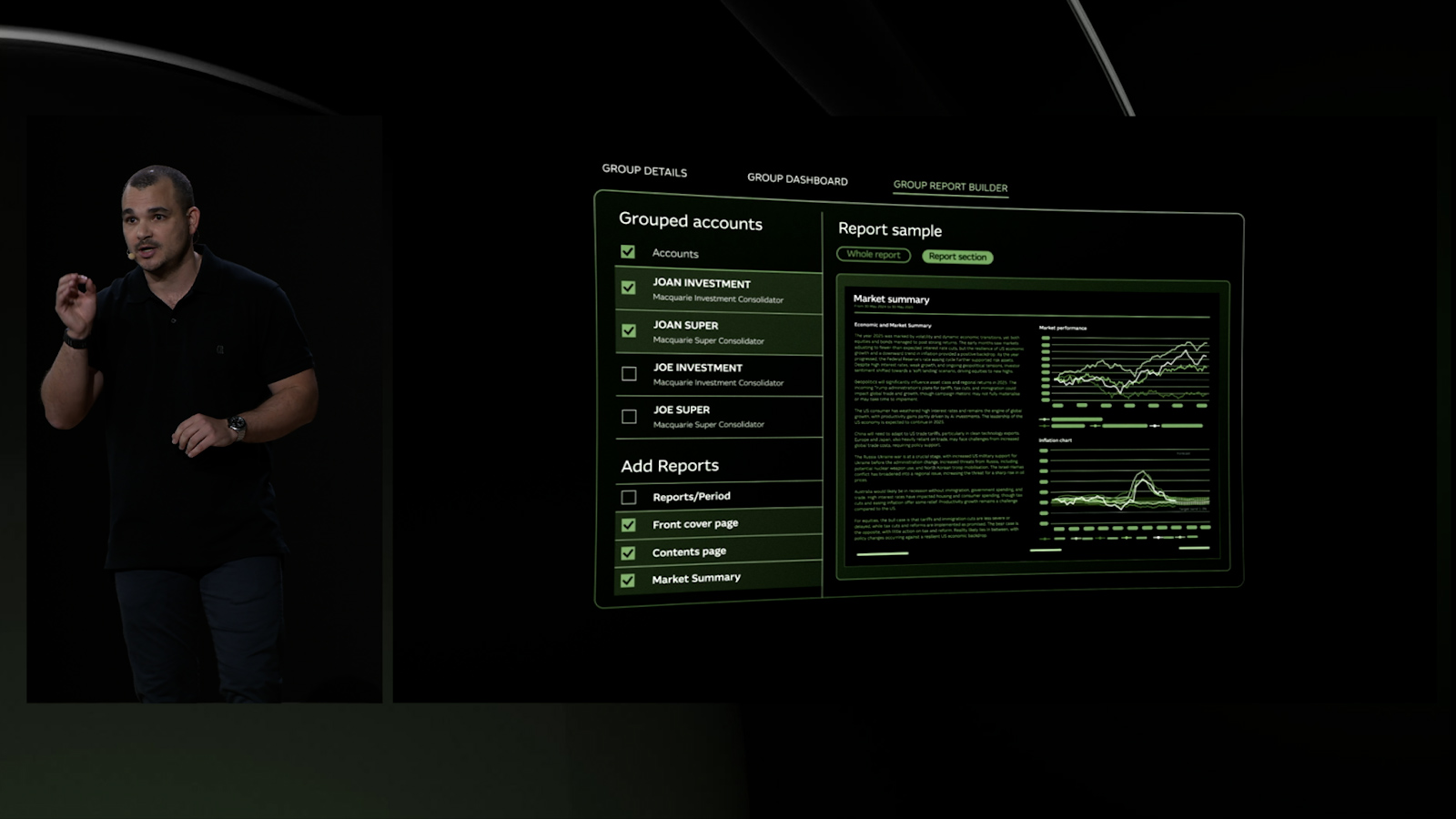
 | Report Builder with AI and secure digital delivery: AI-generated market commentary tailored to the client’s holdings, drag-and-drop customisable layout, and delivery via authenticated push notification (not email), providing a bespoke feel to clients without you needing to do the manual effort. |
Watch now
Loading video...
Watch this video to see how AI in Adviser Online will allow advisers to create market summaries based on market data and client portfolio holdings, creating more personalised and customisable reports for clients.
With a single, consistent design pattern (initiate → notify → approve → track → complete) applied universally, and everything accessible ‘one click from the account overview’, Adam emphasised how the changes will reduce navigation, eliminate paper, and give advisers real-time transparency – all within a security-first framework.
Echoing this, Michelle commented, “We actively listen to your feedback. We understand your drivers and challenges, and the decisions that we make every day are based on that deep understanding of what you need, along with the industry and, importantly, the regulation.”
Looking ahead, higher-capability AI models, such as the latest Google Gemini technology, will see Macquarie introduce further improvements – including streamlining the onboarding of trust deeds, using automated document reasoning and instantly extracting settlors, trustees, and beneficiaries.
Together with a design methodology inspired by Google and comprised of five pillars – scale fast and smart, uncompromising reliability, AI-first, seamless simplicity, security-by-design – advisers can have confidence that every feature Macquarie is building for the adviser platform is designed to provide efficiency, security and support them in deepening their client relationships.
Part three will provide actionable insights on scaling a financial advice business and how to address the common challenges advisers face when trying to scale sustainably, including by sharing key strategies and practical learnings from a successful growth firm and providing insights from our proprietary benchmarking data.